Two people built this.
Aimee Conroy spent twenty-five years behind the chair and has been training hairdressers since she qualified at twenty. Inge Mulligan spent twenty years keeping large, expensive projects on schedule and inside budget. One of them teaches. The other makes sure there’s something solid to teach inside.
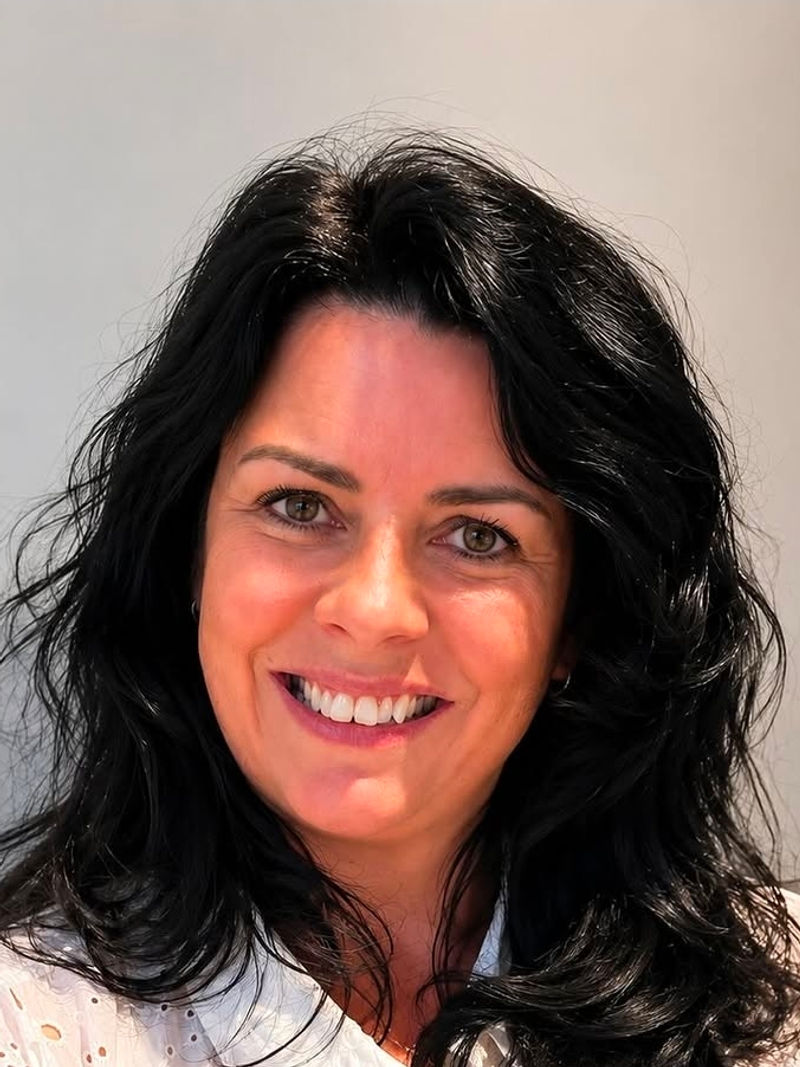
Aimee Conroy.
Twenty-five years, and she’s still figuring things out.
Aimee qualified at twenty, which was young then and would be almost unheard of now. She’s worked in some of the best-known salons in Kilkenny and beyond, competed in the L’Oréal Colour Trophy, and was recognised at the Image Awards in 2015. She’s spent the last quarter century behind the chair.
“Back in the day, there was no certificates. There was no nothing.”
Aimee is straightforward about this. Anyone who trained in hairdressing more than a decade ago has very little paperwork to show for it, because accreditation arrived in this industry recently and the certificates that did exist weren’t treated as important. Hers went the way most people’s did.
Her view on what actually matters: “Hairdressing is mostly practical. It’s 90 percent practical. If you’re not good with your hands, you’re not going to be a good hairdresser.”
Twenty-five years of work is the qualification. The course she has built is the paperwork this generation will have — designed so nobody else has to give that answer.
20
hairdressers trained after hours
Six in the evening until eleven at night.
In the salons Aimee worked in, training the juniors happened after hours. The top stylists didn’t want it: it meant starting at six, finishing near eleven, and you were lucky to be paid for it.
She took it on. “I would have had loads of them, because I was the only one that was so enthusiastic and wanted to do it.”
Around twenty people learned from her that way, squeezed into the end of long days. She can’t remember most of their names. She remembers wanting to do it.
“Nobody is beneath anybody. Everybody is on the same level, no matter who you are, gender, whatever, I don’t care. Everybody should be able to sweep the floor. Everybody should do that. Everybody should be helping each other. We’re trying to raise each other up, not tear each other down.”
Ask Aimee what it was like coming up as a junior and the answer arrives fast: “Can I say it was disgusting?”
Back then, stylists were untouchable and juniors were staff to be used. Her frustration is still with the logic of it: “What they didn’t realise is these girls were them years ago.”
It’s better than it was. Aimee still wouldn’t want her own daughter learning the way she did.
So there are no juniors here. There are no sweepers. Aimee sweeps her own floor.
You can’t put a hairdresser in a uniform.
Somebody asked Aimee recently what the dress code is. Her answer: hairdressers are creative people, and you can’t hand a creative person a uniform. Mostly black, because colour doesn’t show on it, and past that it’s up to you. Tattoos, whatever you like.
“We’re the creative ones,” she says. She thinks this course is going to change how hairdressers get looked at.
The academy she wishes she’d had.
Aimee is not an academic and says so cheerfully. Writing this course has been the hardest work she’s done. She’s done it because the old apprenticeship model pulled the creativity out of people, held juniors through years they didn’t need, and lost good hairdressers along the way.
Asked what she wants graduates to feel on their last day, she couldn’t get through the answer. “I’d be bawling. It’s a huge, huge achievement. They should be super proud of themselves.”
“I wish this was around when I was doing it.”

Inge Mulligan.
The business behind the craft.
Aimee runs the craft. Inge runs everything holding it up.
She spent twenty years in construction, fourteen of them with an international engineering company building power infrastructure across several countries. Her job was the money. At one point she was managing the financial performance of more than twenty-five projects at the same time, in a division turning over around forty million dollars a year. One of those was a ninety million dollar build, delivered inside budget and on deadline.
She moved to Ireland, became a shareholder and director of a passive fire protection company, and at the end of 2025 sold her stake in it.
She sold a business to start this one.
Inge leads the planning, the governance, the finances and the growth of the Academy. In practice that means when you commit eighteen months and a lot of money to a school in its first year, there is someone here whose entire career has been keeping complicated, expensive things on track.